
Soltek Blog
Soltek has been serving the Austin area since 2019, providing IT Support such as technical helpdesk support, computer support, and consulting to small and medium-sized businesses.
Why "It Looked Legit" Is How Most Cyber Incidents Start

Think about your morning routine. You sit down with your coffee, open your inbox, and start clearing out the noise. Among the newsletters and internal updates, you see an urgent notification: a vendor invoice is overdue, a cloud storage subscription failed to renew, or a major shipping provider needs you to confirm delivery details.
The branding looks correct. The email address seems familiar. You click the link, log in to resolve the issue, and move on with your day.
Minutes later, a silent crisis begins.
In the world of modern cybersecurity, attackers rarely hack their way into small and medium-sized businesses (SMBs) through complex software vulnerabilities. Instead, they simply log in. They do this by convincing smart, busy professionals to hand over the keys.
The Evolution of the Deceptive Email
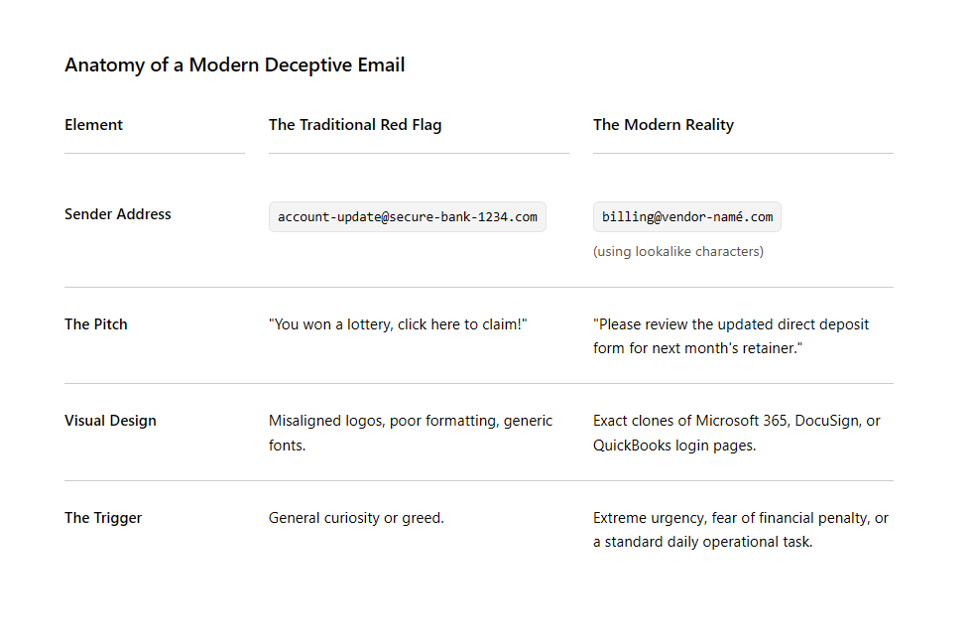
Gone are the days when cyberthreats were easy to spot. We all remember the era of the "Nigerian Prince" scams or emails riddled with obvious typos, broken English, and sketchy attachments. Today's tactics are highly sophisticated, engineered specifically to bypass both technical filters and human suspicion.
Modern social engineering attacks—often referred to as business email compromise (BEC) or spear phishing—rely on psychological manipulation rather than technical wizardry. Attackers research your company, map out your vendor relationships via public data or LinkedIn, and create highly targeted, context-aware messages.
They don't need to look like an obvious criminal; they just need to look legit.
Why SMBs Are the Primary Target
A common misconception among business owners is: "We are too small for hackers to care about."
In reality, small and medium-sized businesses are the sweet spot for cybercriminals. Large enterprises invest millions in dedicated, around-the-clock security operations centers. SMBs, however, often operate with lean internal teams where employees wear multiple hats. A busy HR manager or accounting clerk is juggling dozens of tasks a day—making them far more susceptible to a well-timed, urgent request.
The risks of a single employee clicking the wrong link are no longer limited to a slow computer. Today, a successful credential theft can lead to:
- Financial Fraud: Attackers intercepting wire transfers or diverting legitimate vendor payments to fraudulent accounts.
- Ransomware: Total operational paralysis as business data is encrypted and held for ransom.
- Reputational Damage: If an attacker gains control of your email system, they will use your legitimate domain to launch attacks on your clients, permanently fracturing hard-earned trust.
Building a Culture of Verification
Technology is vital, but even the most advanced AI-driven email filters cannot stop every single threat. The final line of defense is always the person sitting at the keyboard.
Shifting your business from a posture of vulnerability to one of resilience doesn't require turning your employees into cybersecurity experts. It requires shifting the cultural norm from implicit trust to healthy skepticism.
1. Normalize Out-of-Band Verification
If an email requests a change in payment details, sensitive data transfer, or urgent credential verification, establish a strict policy: Verify via a secondary channel. Call the vendor using a known phone number (not the number listed in the suspicious email) or ask a colleague across the room. A 30-second phone call can save a business hundreds of thousands of dollars.
2. Move Past "Once-a-Year" Training
Cyberthreats evolve weekly. Sending out a dense, compliance-driven training video once a year does not change behavior. Effective security awareness involves continuous, bite-sized education and simulated testing that mimic real-world scenarios, helping employees keep security top of mind in their daily routines.
3. Implement Guardrails That Reduce Human Error
We cannot expect perfection from humans 100% of the time. People get tired, distracted, and stressed. That’s why technical guardrails must exist to catch mistakes. Implementing robust Multi-Factor Authentication (MFA), strict conditional access policies, and automated endpoint protection ensures that even if a password is accidentally surrendered, the attacker still cannot breach the environment.
Securing Peace of Mind
Managing the intersection of human behavior and digital security can feel overwhelming for a growing business. It requires balancing strict protections with operational efficiency so your team can actually get their work done.
This is where having a strategic IT partner becomes invaluable. True cybersecurity isn't about buying a piece of software and hoping for the best; it's about designing an ecosystem where advanced technical layers, proactive monitoring, and continuous human education work in tandem. When your defensive posture is structured correctly, it lifts the burden of constant worry off your shoulders, giving you the clarity and freedom to focus entirely on scaling your business.
Concerned about your business' vulnerability to sophisticated phishing or social engineering cyberthreats? Reach out to our team today for a comprehensive security assessment.
About the author
Comment for this post has been locked by admin.
Comments
No comments made yet. Be the first to submit a comment
News & Updates
Soltek is proud to announce the launch of our new website at www.soltek.io. The goal of the new website is to make it easier for our existing clients to submit and manage support requests, and provide more information about our services for ...
Understanding IT
Get the Knowledge You Need to Make IT Decisions
Technology is constantly evolving, and keeping up can feel overwhelming. Whether you want to understand cybersecurity threats, explore automation, or learn how regulations like PCI DSS impact your business, we’ve made it easy to access clear, straightforward insights on key IT topics.